Blog
- Home
- Blog
Jib Crane vs. Manual Handling: A Complete Cost Savings Analysis
In today’s competitive manufacturing and processing industry, profit margins often hide in everyday operations. Many factory managers focus on raw material procurement, CNC machine depreciation, or supply chain optimization. Yet, they ignore the most basic and frequent action in the workshop—material handling. Walking into a machining workshop, if you see workers bending over, lifting heavy parts together, or waiting for forklifts, your profits are evaporating. Upgrading manual handling to a workstation-level jib crane: Is it an extra expense or a high-return investment?
This article analyzes the cost game between jib cranes and manual handling from direct costs, hidden losses, productivity, and safety risks.
The “Hidden Cost” Trap of Manual Handling
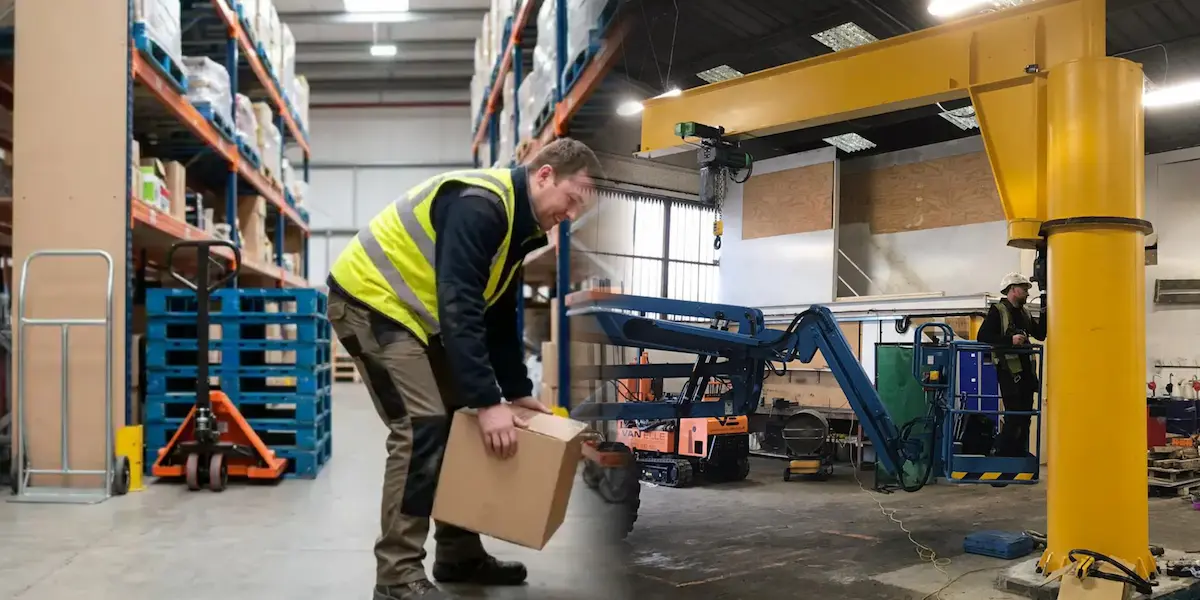
Many enterprises only calculate basic wages when evaluating manual handling. The real cost of manual handling often hides where financial statements cannot see.
●Efficiency Bottlenecks and Machine Idling: In machining, machine operation rate is a lifeline. If a worker spends 20% of their day loading heavy blanks onto machines, or waits for colleague assistance during handling, this expensive million-yuan machine sits idle. Manual handling pace is uncontrollable, directly delaying the overall Takt time.
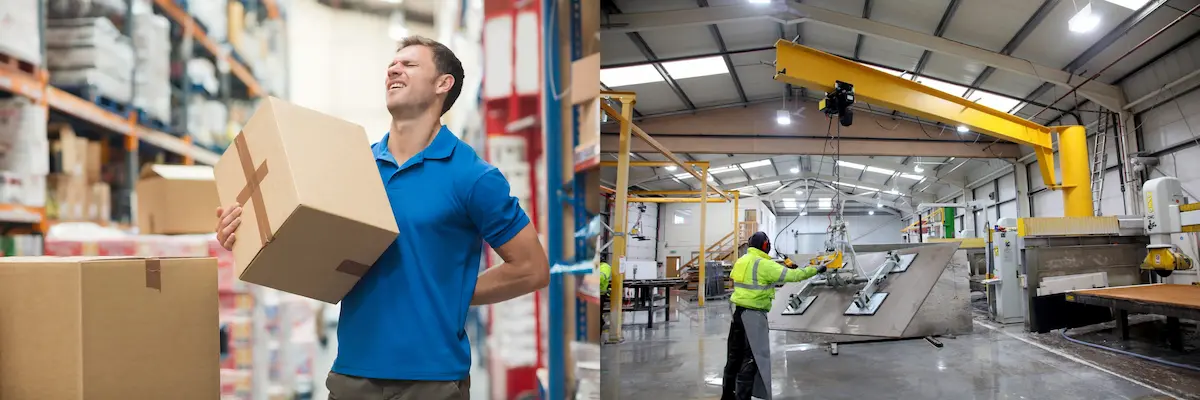
●Workers’ Compensation and Medical Costs: Long-term, repetitive heavy lifting causes musculoskeletal disorders (MSDs). A severe back sprain brings long-term sick leave pay, high compensation claims, and team productivity drops for weeks. Industry statistics show back injuries from improper material handling are the most common manufacturing injuries.
●Turnover and Recruitment Costs: Modern manufacturing faces aging and labor shortages. Young workers reject high-intensity manual labor, making heavy physical roles hard to retain. High turnover means continuous spending on recruitment and safety training.

Jib Crane: Workstation-Level Efficiency Revolution
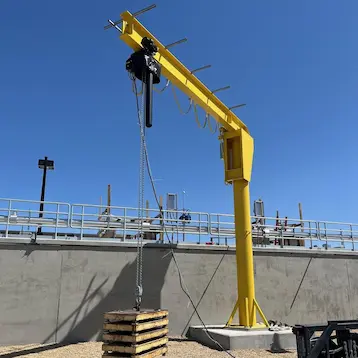
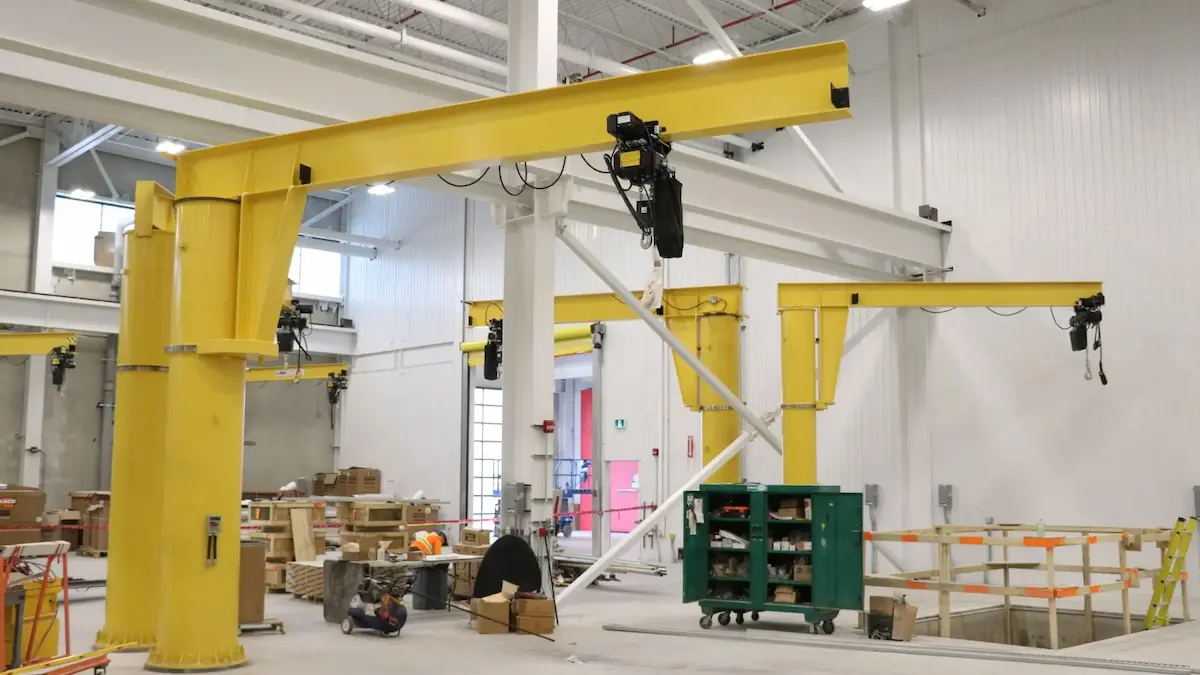
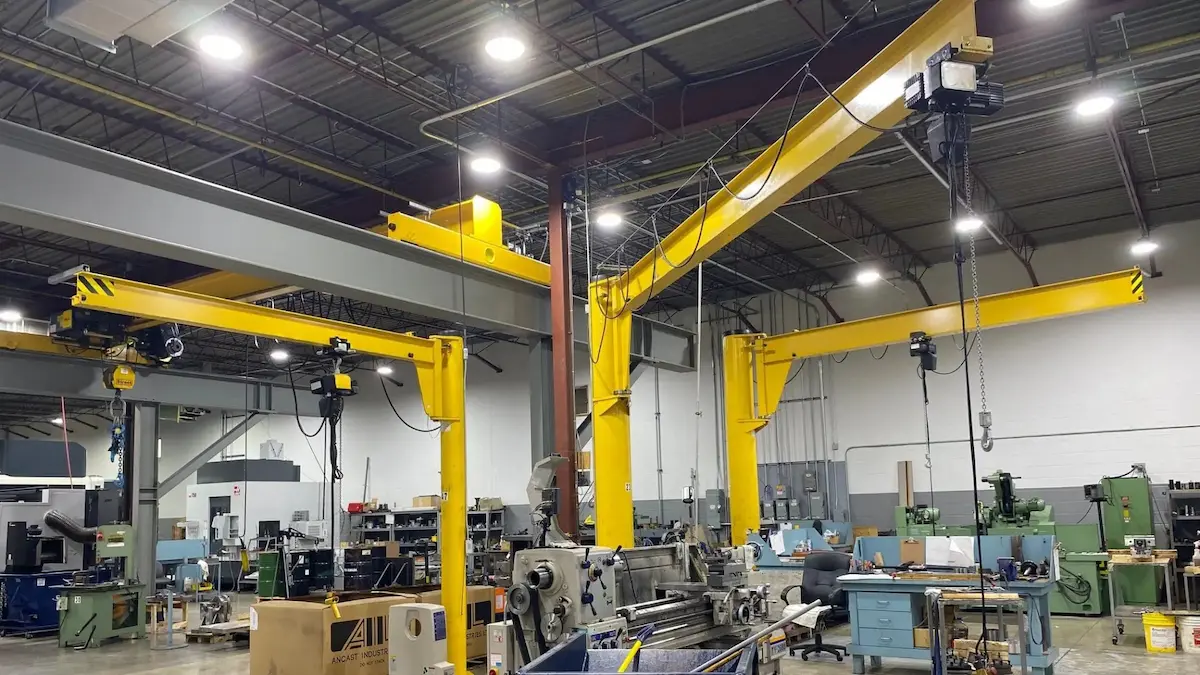
Unlike overhead cranes covering entire workshops, jib cranes (pillar or wall-mounted) are “precision strike” tools designed for local workstations. They return heavy lifting control directly to equipment operators.
●Instant Response: Workers don’t need to call forklifts or wait for overhead cranes. They can lift anytime, eliminating wait times.
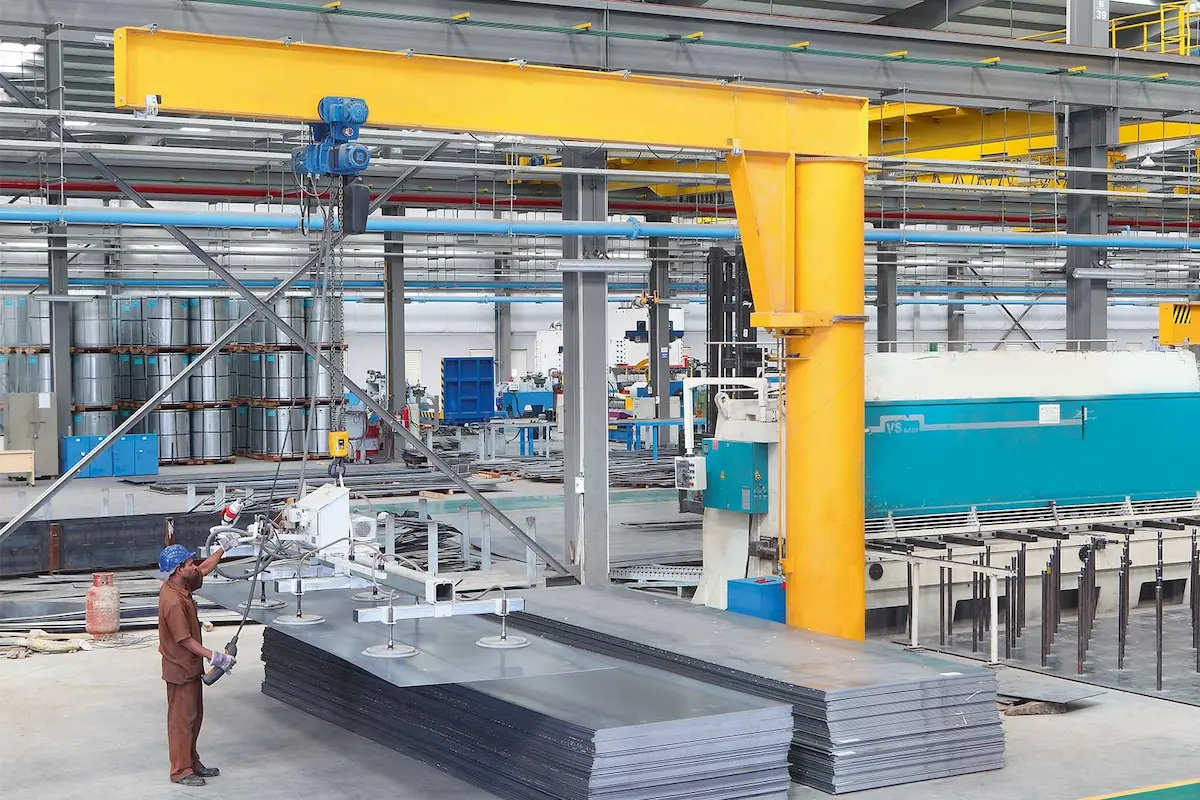
●Precise Positioning: Paired with chain electric hoists or pneumatic balancers, jib cranes achieve millimeter-level assembly precision. This is critical for mold changes or precision machining parts loading.
●High Space Utilization: Wall-mounted jib cranes take up zero floor space. Pillar-mounted versions have tiny footprints and offer up to 360-degree rotation coverage.
Core Showdown: Cost Savings Quantitative Analysis
To show differences directly, let’s check how jib cranes reduce comprehensive operating costs across dimensions.
|
Evaluation Dimension |
Traditional Manual Handling |
Jib Crane Assisted Handling |
Cost Saving / Advantage |
| Direct Labor | Needs 2-3 people for items over 25kg | 1 operator can finish easily | Reduces redundant labor, lowers unit labor cost |
| Operation Time | Slow, limited by human fatigue | Fast, stable lifting and rotation | Boosts machine utilization and daily output |
| Waiting Cost | Waits for colleagues or forklifts, machine idles | Dedicated equipment, ready to use | Eliminates idle time, improves OEE |
| Safety Risk | Extremely high (strains, drops, slips) | Extremely low (ergonomic design) | Saves massive injury compensation and insurance |
| Product Loss | Prone to bumps and scraps from drops | Smooth lifting, protects surfaces | Lowers scrap rate, ensures product quality |
ROI (Return on Investment) Simulation Case Study
Assume a machining workshop has a CNC lathe requiring 50 loading operations daily (about 40kg).
●Manual Mode: Each operation requires two workers, taking about 5 minutes. Daily total is 250 minutes (approx. 4 hours). At 30 RMB per hour, daily labor cost is 2×4×30=240 RMB. Annual cost (250 workdays) is 60,000 RMB.
●Jib Crane Mode: Investing in a pillar-mounted jib crane (with electric hoist) costs about 15,000 RMB. One operator finishes independently, cutting time to 2 minutes. Daily time drops to 100 minutes (approx. 1.6 hours). Annual labor cost is 1×1.6×30×250=12000 RMB.
Conclusion: Just in direct labor time for a single machine, enterprises save 48,000 RMB yearly. This excludes extra product profits from faster loading. The payback period of this jib crane is less than 4 months!
Strategic Advantages Beyond Book Numbers
Besides obvious financial figures, deploying proper lifting equipment in the workshop brings far-reaching strategic impacts to enterprises:
1.Build an “Ergonomic” Friendly Workshop: Entrusting heavy handling to machines is the best protection for employees. This greatly boosts employee satisfaction and loyalty. It also becomes a major highlight during recruitment. No longer limited by workers’ physical strength, enterprises can hire more experienced skilled veterans with declining physical strength, or increase the proportion of female employees.
2.Enhance Customer Factory Audit Pass Rates: For many factories undertaking international or high-end manufacturing orders, customer audits are strict hurdles. Having a complete material handling system and high-standard safety protection measures proves to customers that your company has stable, safe, and modern delivery capabilities.
3.Flexibly Adapt to Capacity Expansion: When orders surge, manual handling efficiency has a physical upper limit. Human wave tactics are chaotic in management and costly. Jib cranes can output continuously at a stable rhythm, perfectly matching high-intensity three-shift production rhythms, providing solid guarantees for enterprise capacity ramp-up.
How to choose the right jib crane for your workshop?
Since jib cranes bring huge cost savings, selection becomes critical. Blindly purchasing mismatched equipment causes resource waste.
●Confirm Workspace and Building Structure: If workshop column load-bearing allows, wall-mounted jib cranes are the most cost-effective choice without occupying floor space. If there are no suitable walls or columns, pillar-mounted jib cranes provide stable support and 360-degree all-around coverage.
●Accurately Calculate Lifting Capacity and Arm Length: Do not blindly pursue large tonnages. If daily handled parts are around 100kg, purchasing a 500kg-class jib crane matched with a fast lightweight chain hoist yields smoothness and efficiency far better than a bulky 2-ton device. The arm length only needs to cover the workstation and unloading area. An overly long jib increases terminal operation inertia.
●Consider Special Environment Demands: In food processing, cleanrooms, or chemical workshops with explosion-proof requirements, you must choose special jib cranes of corresponding materials (such as stainless steel) or through explosion-proof certification.
Conclusion: Let handling no longer be a stumbling block to efficiency
In the wave of “Industry 4.0″ and smart manufacturing, automation core is not just expensive robots, but how to eliminate inefficient links in manual operations through economical and reliable means.
For the vast majority of manufacturing enterprises, upgrading manual handling to a jib crane is a low-threshold, zero-risk, high-return improvement initiative. Do not let your skilled technicians waste valuable energy on heavy lifting. Free their hands with a jib crane and turn every lift into solid enterprise profits.
This document is for reference only. Specific operations must strictly comply with local laws and regulations and equipment manuals.
Recent Post